

Carbon Fiber Furniture: How Carbon Fiber is Redefining Luxury Furniture Design
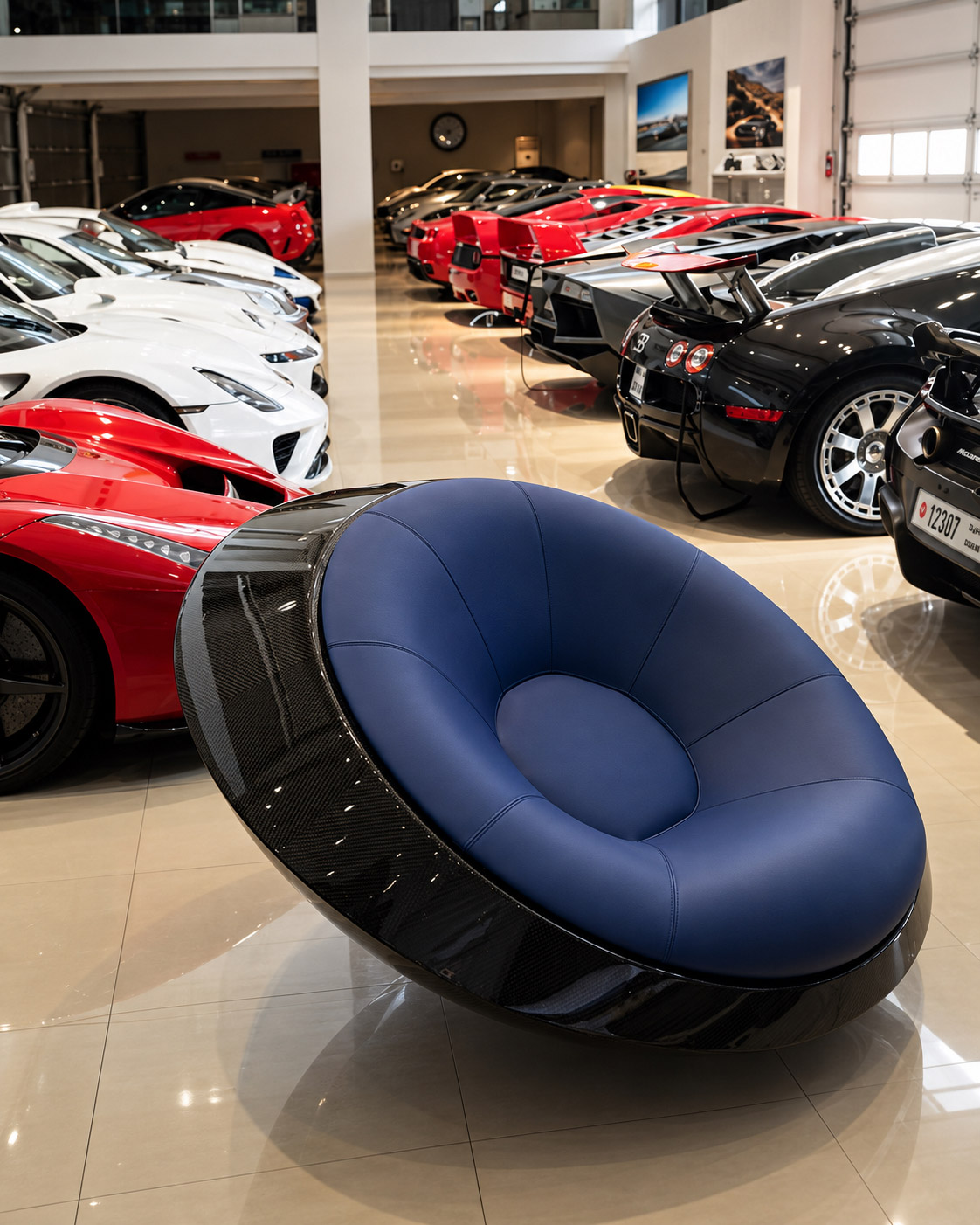
Carbon fiber furniture sits at the intersection of material science, engineering and contemporary design. Once associated primarily with aerospace, motorsport and high-performance engineering, Carbon fiber has become an increasingly distinctive material for furniture, interiors and collectible design.
Its appeal is not simply visual. Carbon fiber combines low density with high specific strength and stiffness, allowing designers to explore structural solutions and proportions that can be difficult to achieve with more conventional materials. But the real value of Carbon fiber furniture lies in how the material is translated into an object: through fibre orientation, composite construction, moulding, curing, finishing and, in some cases, meticulous handcrafting.
For luxury interiors, this creates a particularly interesting design language. Carbon fiber can remain visibly technical, with its characteristic weave becoming part of the aesthetic, or it can be integrated into a sculptural object where the material’s engineering qualities support an artistic form.
What Is Carbon fiber Furniture?

Carbon fiber furniture is furniture that uses Carbon fiber as a structural or significant material component in the construction of a piece.
This distinction matters because Carbon fiber is not normally used in furniture as a solid block of carbon. Carbon fiber consists of extremely fine carbon-rich filaments that are generally used as reinforcement within a composite material. The fibres provide much of the strength and stiffness, while a matrix, commonly a polymer resin, binds the fibres together and transfers loads between them.
Carbon fiber is defined as a fibre containing at least 92% carbon by weight. It is valued primarily for its combination of low weight and high mechanical performance.
ScienceDirect reports that commercial Carbon fibers can have tensile strengths in the range of approximately 3 to 7 GPa and Young’s moduli around 200 to 500 GPa, although properties vary substantially according to fibre type, precursor and manufacturing process.
These figures describe the fibre itself, not automatically the finished furniture. Once Carbon fiber becomes part of a composite structure, the performance of the final component depends on factors including fibre orientation, fibre content, matrix properties, geometry and manufacturing quality.
What makes Carbon fiber different from carbon-look furniture?

A carbon-look finish is not the same thing as Carbon fiber construction.
A furniture piece may reproduce the visual pattern of woven Carbon fiber through a printed, laminated or decorative surface while being made from another material underneath. In genuine Carbon fiber furniture, Carbon fiber is actually incorporated into the structure or material system.
This distinction is particularly relevant in collectible and luxury design, where the material itself can be part of the identity and value of the object.
The visible weave can therefore communicate something real about the construction, although the appearance alone is not sufficient to determine how much Carbon fiber is actually used or what structural role it performs.
Why Is Carbon fiber Used in Furniture Design?
The attraction of Carbon fiber begins with its mechanical properties, but its significance in furniture design goes further.
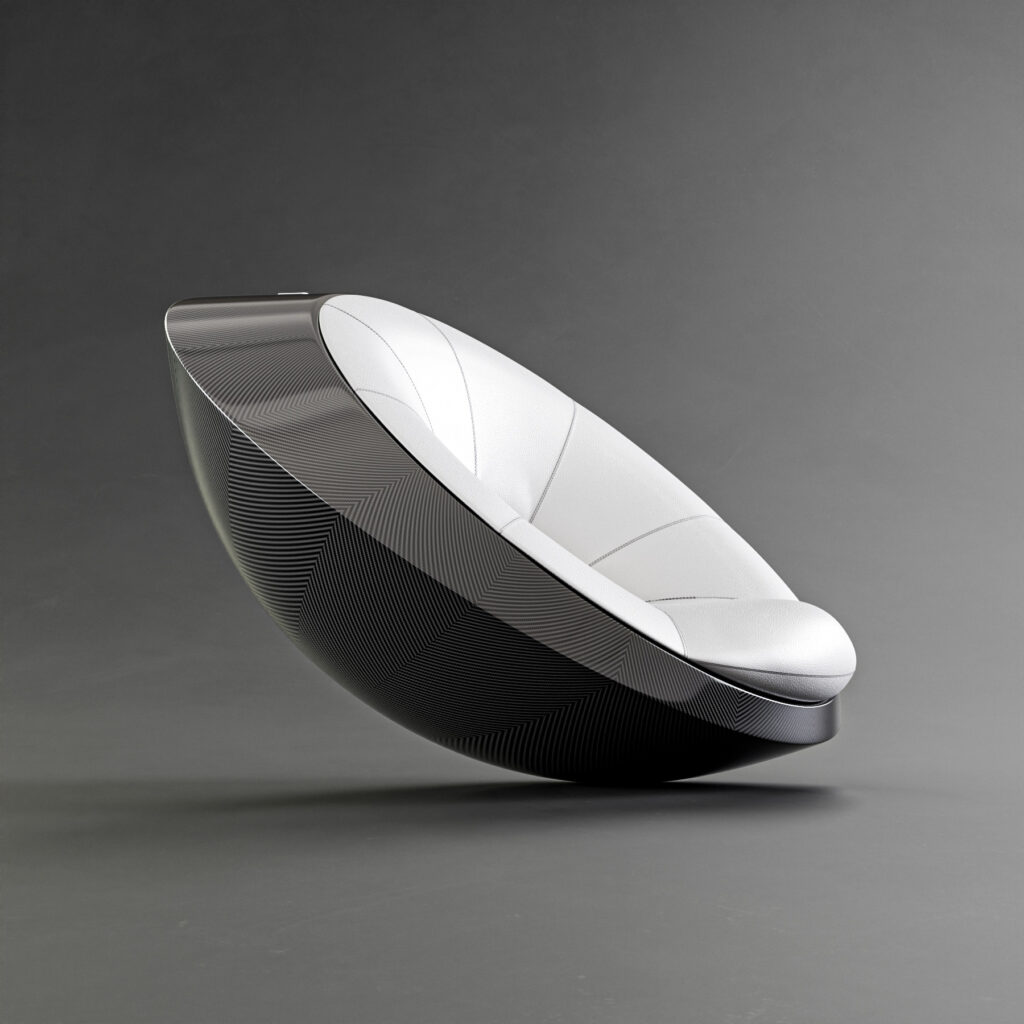
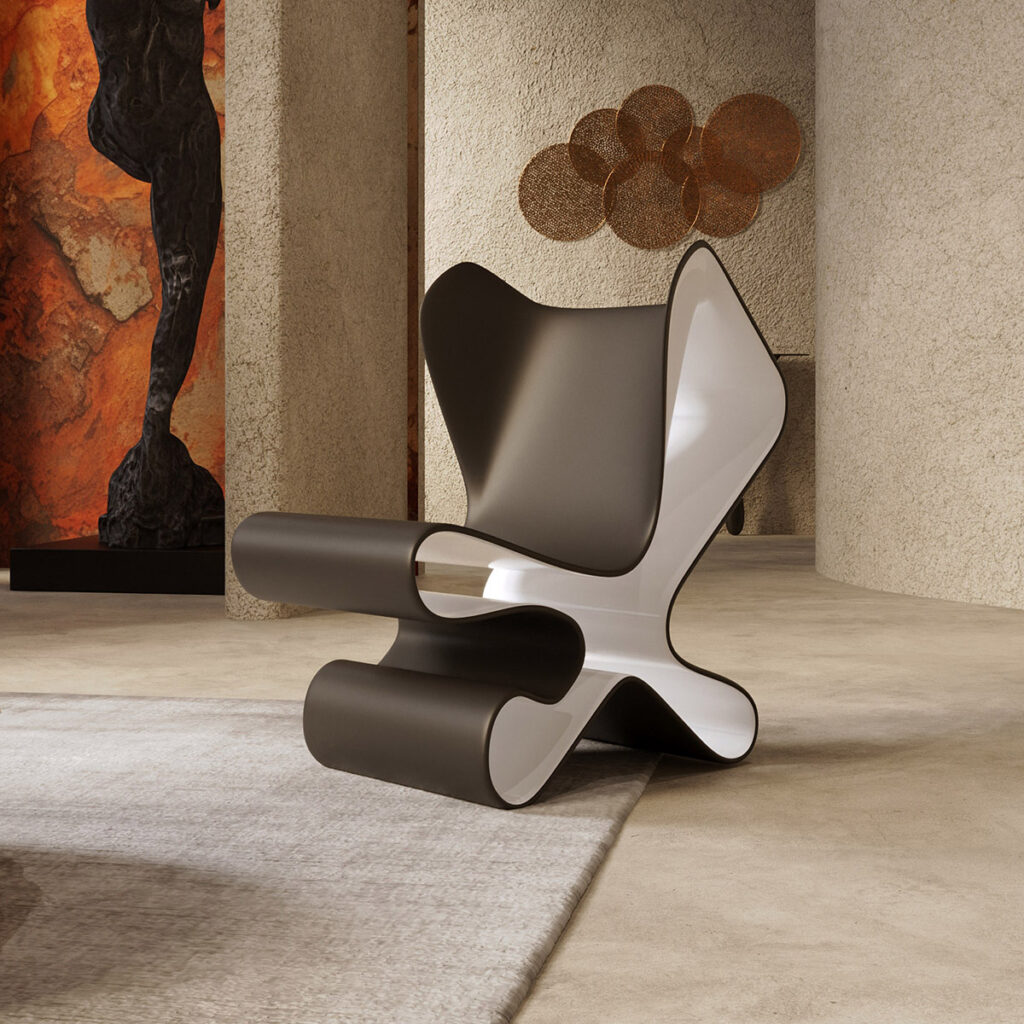
Ufo Carbon Fiber
Carbon-fiber shell in gloss or matte, paired with fabric, velvet or leather upholstery.
Discover the iconHigh strength-to-weight ratio
Carbon fiber is widely used as a reinforcement because of its high specific strength and stiffness. In simple terms, designers can obtain substantial mechanical performance without relying solely on large quantities of dense material.
This is one reason Carbon fiber became important in industries where weight matters. ScienceDirect identifies high specific tensile strength, high modulus and low density among the key characteristics that make Carbon fibers attractive for structural applications.
For furniture, the implication is not simply that every Carbon fiber chair or table must be lighter than every conventional equivalent. Rather, the material gives designers another set of structural possibilities.

Lightweight structures and new proportions
Reducing mass can become a design opportunity.
A structural element that does not need to be visually heavy can contribute to a more open composition. Thin shells, narrow structural sections and apparently suspended forms become easier to explore when the material and engineering strategy support them.
This is where Carbon fiber becomes particularly interesting for sculptural furniture. The objective is not to make an object look technical for its own sake. The material can help the designer make structure part of the visual language.
Structural freedom and sculptural forms
Carbon fiber is anisotropic, meaning its mechanical behaviour depends strongly on direction. The orientation and arrangement of the fibres therefore matter.
This characteristic requires a different approach from simply carving a shape from a homogeneous block of material. Designers and engineers can orient fibres according to the loads that the structure is expected to withstand.
Research into Carbon fiber processing also shows how fibre microstructure, processing conditions and orientation influence the resulting mechanical and physical properties.

For furniture designers, this opens a dialogue between engineering and form. The structure does not merely support the design. It can help determine it.
Durability and resistance
Carbon fiber composites can offer excellent mechanical performance and fatigue resistance, but it would be misleading to describe Carbon fiber furniture as universally indestructible.

ScienceDirect identifies low impact resistance and low strain-to-failure among the limitations of Carbon fibers.
The performance of a finished furniture component therefore depends on the entire composite system and its design, not on the Carbon fiber alone.
For a high-end furniture piece, correct engineering, manufacturing quality, protection of the surface and appropriate use are all part of the equation.
How Is Carbon fiber Furniture Made?
There is no single manufacturing method for every Carbon fiber furniture piece. Processes vary according to the geometry, structural requirements, resin system, production scale and desired finish.
A typical composite manufacturing sequence can involve several stages.
Designing the mould and structure

The process begins with the geometry.

For sculptural furniture, the mould is particularly important because it determines the final shape and often the way the composite will carry loads.
At this stage, designers and engineers must consider more than appearance. Fibre direction, thickness, joins, load paths and manufacturing constraints all influence the final result.
Carbon fiber lay-up

Carbon fiber is supplied in different forms, including woven fabrics and unidirectional materials.
During lay-up, layers are positioned according to the intended structural behaviour. The orientation of these layers is important because Carbon fiber performs most effectively along the direction of the fibres.
The result is not simply a decorative skin. In a properly engineered composite, the arrangement of the reinforcement is part of the structural design.

Resin and composite formation
The fibres need a matrix to form the finished composite.
In many applications, polymer resin is used to bind the fibres together and transfer loads between them. Research literature describes Carbon fiber composites using different matrices and highlights the importance of the fibre-matrix interface to the resulting properties.
The quality of this stage has a direct influence on the final component.
Curing and autoclave processing
An autoclave is a pressurised vessel used in certain composite manufacturing processes to consolidate and cure materials under controlled temperature and pressure.
It is an important technology, but it should not be presented as an obligatory step for all Carbon fiber furniture.

Mavimatt explicitly uses autoclave processing for specific Carbon fiber pieces. The Carbon edition of Meteora, for example, is described as having a Carbon fiber chassis produced through a special autoclave process.
Mavimatt also describes the Carbon fiber Edition of Nido as being handmade from a carbon monoblock and subsequently finished through special autoclave processes.
Finishing the Carbon fiber surface
The final appearance can dramatically change the character of Carbon fiber furniture.

A carbon surface may be left visible, finished with a matt or glossy treatment, or combined with colour while retaining the characteristic fibre texture.
For luxury furniture, finishing is not simply cosmetic. It determines how the material interacts with light and with the other materials used in the piece.

Handcrafted versus industrial production

Carbon fiber is often associated with highly industrialised manufacturing, but composite technology does not necessarily exclude craftsmanship.
The two approaches can coexist.
Mavimatt, for example, describes several Carbon fiber pieces as being processed by hand by its craftsmen. The Carbon edition of Holo has a genuine exposed Carbon fiber central body, processed and applied by hand, with each body worked individually.
This combination of advanced material technology and manual finishing is particularly relevant to collectible furniture, where the production process can become part of the object’s identity.
What Does Carbon fiber Look Like in Furniture?
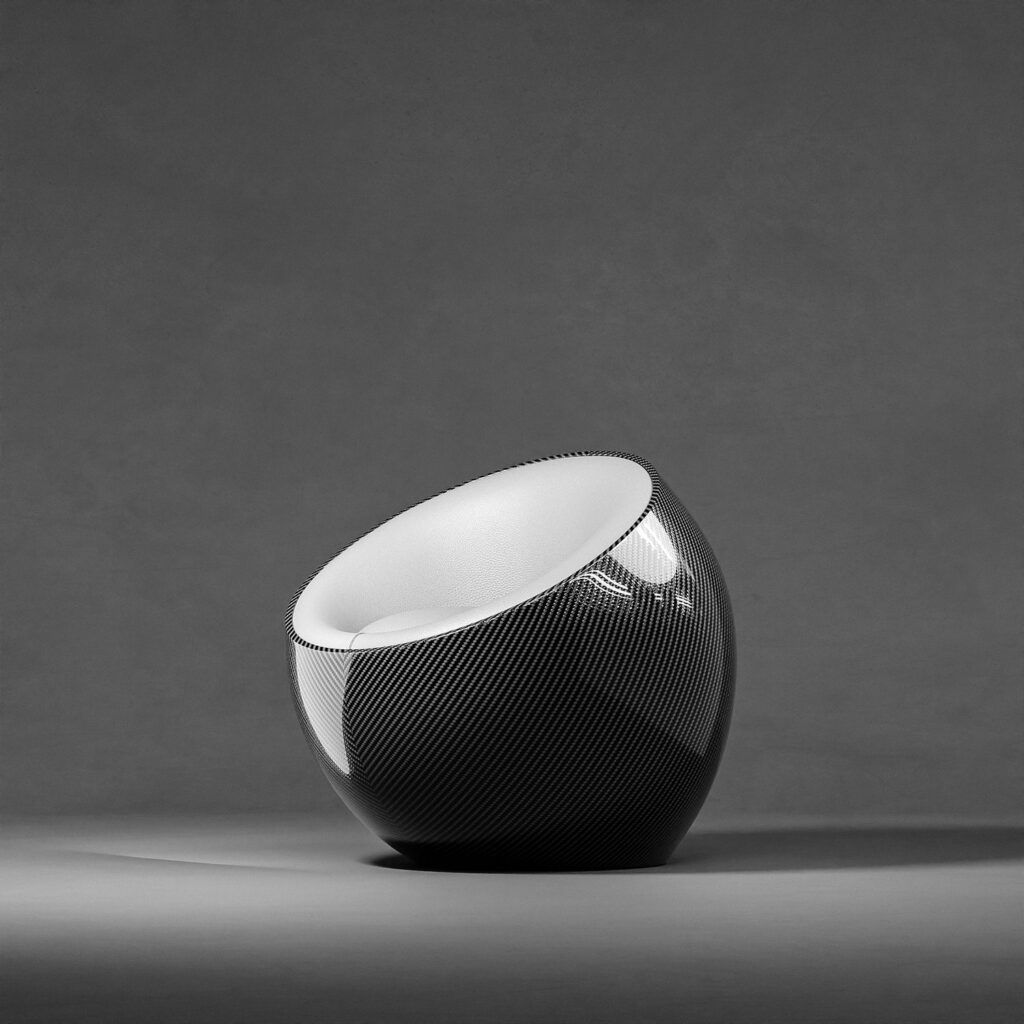
Carbon fiber has a recognisable visual language, but there is no single Carbon fiber finish.
Plain Carbon fiber

Plain Carbon fiber typically reveals the natural structure of the material.
The fibres themselves become part of the surface, creating a pattern that immediately connects the object with advanced engineering and composite construction.
In furniture, this can produce a striking contrast with softer materials such as leather, velvet or textile upholstery.
Twill Carbon fiber
Twill weave produces the diagonal pattern commonly associated with high-performance Carbon fiber components.
The weave is highly visible and can become an important graphic element of the piece.
Forged carbon
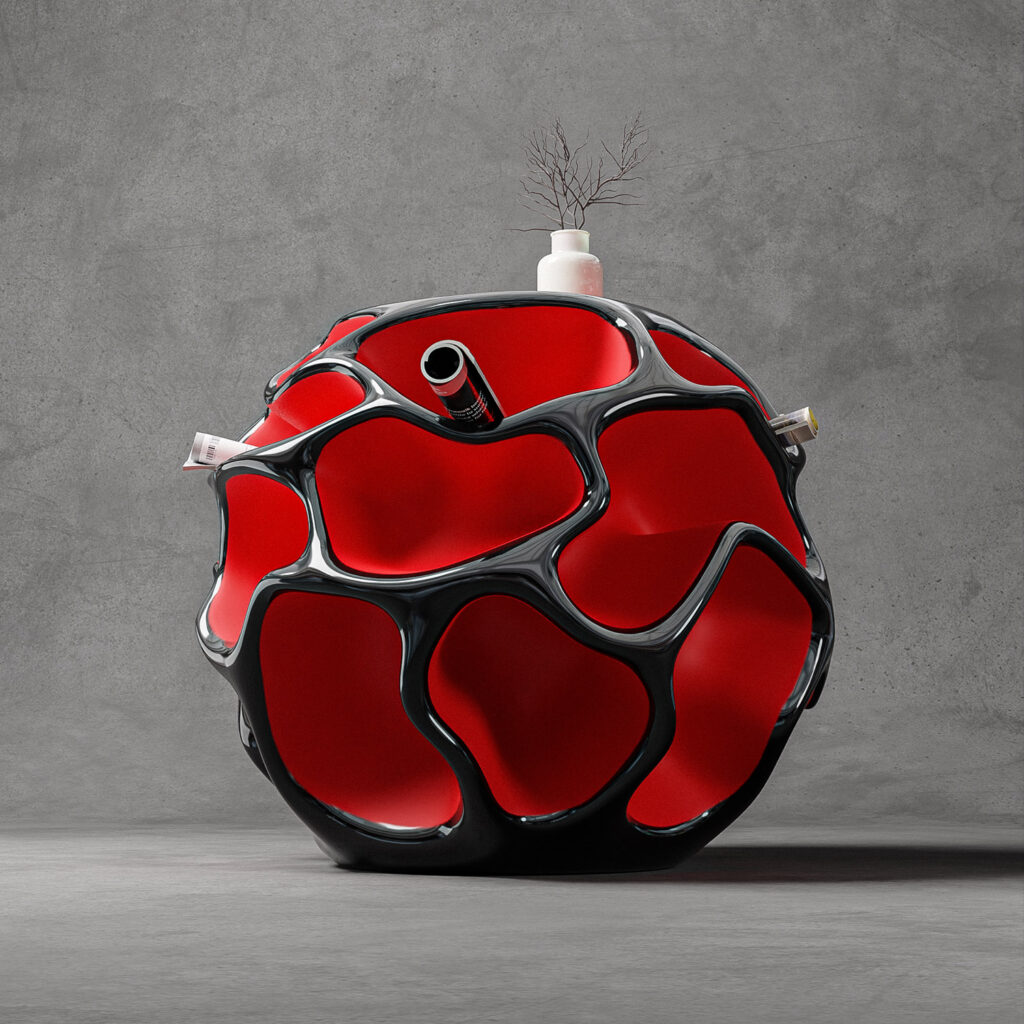
Forged carbon has a different appearance from conventional woven Carbon fiber.
Instead of a regular textile weave, it produces a more irregular, marbled pattern. Its visual character can therefore be useful when the designer wants the material to remain recognisable without creating a strongly patterned surface.
Mavimatt’s U.F.O. Carbon fiber armchair is available with plain carbon and carbon twill, while forged carbon can be requested for special applications.
Gloss or matt finishes
The same carbon structure can produce very different visual effects depending on its finish.
A glossy surface increases reflections and gives the material a more dramatic presence. A matt surface reduces reflections and tends to emphasise the weave and sculptural geometry.
Mavimatt offers both matt and glossy carbon finishes on several pieces, including U.F.O. Carbon Fiber, Meteora and Holo.

Coloured carbon
Carbon fiber does not have to remain black.
Special inks or pigments can introduce colour while preserving the visibility of the underlying carbon texture. Mavimatt uses this approach on several Carbon fiber editions, allowing the material to remain visually identifiable while moving beyond the conventional black-carbon aesthetic.

Carbon fiber Furniture and Luxury Interior Design
Carbon fiber is particularly suited to interiors where furniture is expected to do more than fulfil a practical function.
Its visual identity is immediately recognisable, but it can also disappear into a more sophisticated composition when combined with other materials.
Why Carbon fiber works in contemporary interiors
The material carries associations with technology, precision and performance.
Placed within a contemporary interior, these qualities can introduce contrast against natural stone, wood, leather or textiles. A Carbon fiber object can therefore become a focal point without relying on excessive ornament.
The strongest applications often treat the material as part of the architecture of the object rather than as decoration added afterwards.
From furniture to collectible design

This distinction is central to luxury collectible furniture.
A chair, table or lamp can be technically functional while also operating as a sculptural object. In this context, Carbon fiber is valuable because it can participate in the visual and structural conception of the piece simultaneously.
The material is therefore not simply a finish. It can become part of the design language.
Carbon fiber combined with leather and other luxury materials
The contrast between Carbon fiber and soft upholstery is particularly effective.
The rigid, technical character of the composite can be balanced by leather, velvet or Alcantara. Mavimatt’s U.F.O. Carbon fiber, for example, combines its Carbon fiber chassis with natural Primofiore leather upholstery, available in multiple colours.
Meteora similarly combines its Carbon fiber chassis with leather, velvet or Alcantara upholstery.
The result is not a compromise between technology and luxury. The contrast is precisely what gives the object its character.
What Types of Furniture Can Be Made from Carbon fiber?
Carbon fiber can be incorporated into many different categories of furniture, provided the design and manufacturing process are appropriate to the intended function.
Chairs and armchairs
Seating is one of the most visually compelling applications because the shell itself can become the defining feature of the object.
Mavimatt’s U.F.O. Carbon fiber is an example of this approach. Its Carbon fiber chassis forms the structural identity of the armchair, while the upholstered seat introduces comfort and material contrast.
Sofas and larger seating
Carbon fiber can also be used in larger seating structures, particularly where a designer wants to create a rigid shell or lightweight structural element.
The challenge increases with scale because the structural behaviour, joints and load distribution become more complex.
Coffee tables
Tables provide another natural application.
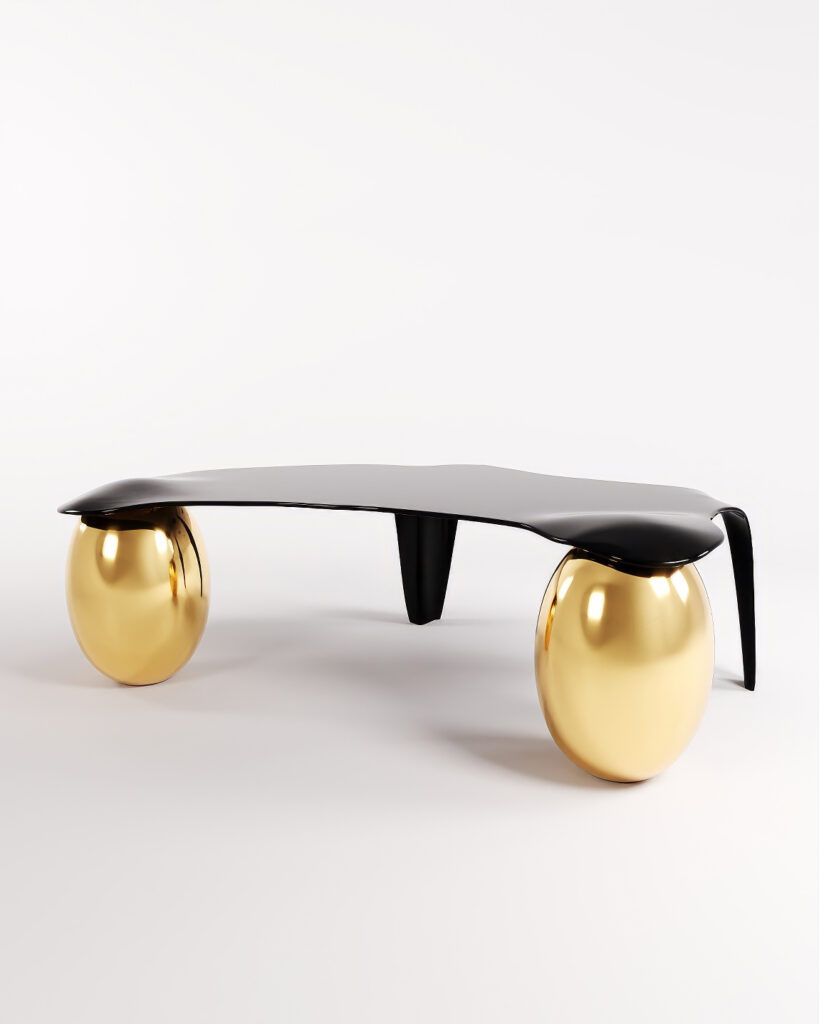
Mavimatt’s Holo Carbon Edition uses genuine exposed Carbon fiber for its central body, combined with aluminium rims. The central body is individually processed by hand, allowing each piece to retain its own character.
Tables and consoles
Carbon fiber can also be used in larger horizontal structures.
Mavimatt’s Nido Carbon fiber Edition is described as being produced by hand from a carbon monoblock, with special autoclave processes and a transparent matt or glossy finish.
Bespoke Carbon fiber furniture
Perhaps the most interesting application is bespoke design.
Because composite construction allows geometry, fibre orientation, surface treatment and combinations of materials to be considered together, Carbon fiber can be particularly suitable for projects requiring a specific shape, dimension or visual identity.
For luxury interiors, this makes bespoke production relevant not only for private residences but also for hospitality, architectural and collectible-design projects.
Mavimatt Carbon fiber Furniture: Where Technology Meets Italian Craftsmanship
Mavimatt approaches Carbon fiber as both a technical material and a design language.
The brand’s collection combines sculptural forms with handmade production in Italy, creating pieces in which material research is part of the creative process.
U.F.O. Carbon fiber

U.F.O. Carbon fiber is the Carbon fiber edition of the U.F.O. armchair and is presented by Mavimatt as a limited edition of 100 numbered pieces worldwide. Each chair receives an individually applied aluminium identification plaque.
Its Carbon fiber chassis is combined with natural Primofiore leather upholstery, with extensive colour customisation. Mavimatt also offers different carbon surface treatments, including matt and glossy finishes.
Here, Carbon fiber is not hidden inside the object. It is deliberately exposed as part of the identity of the armchair.
Meteora Carbon
Meteora takes a different route.
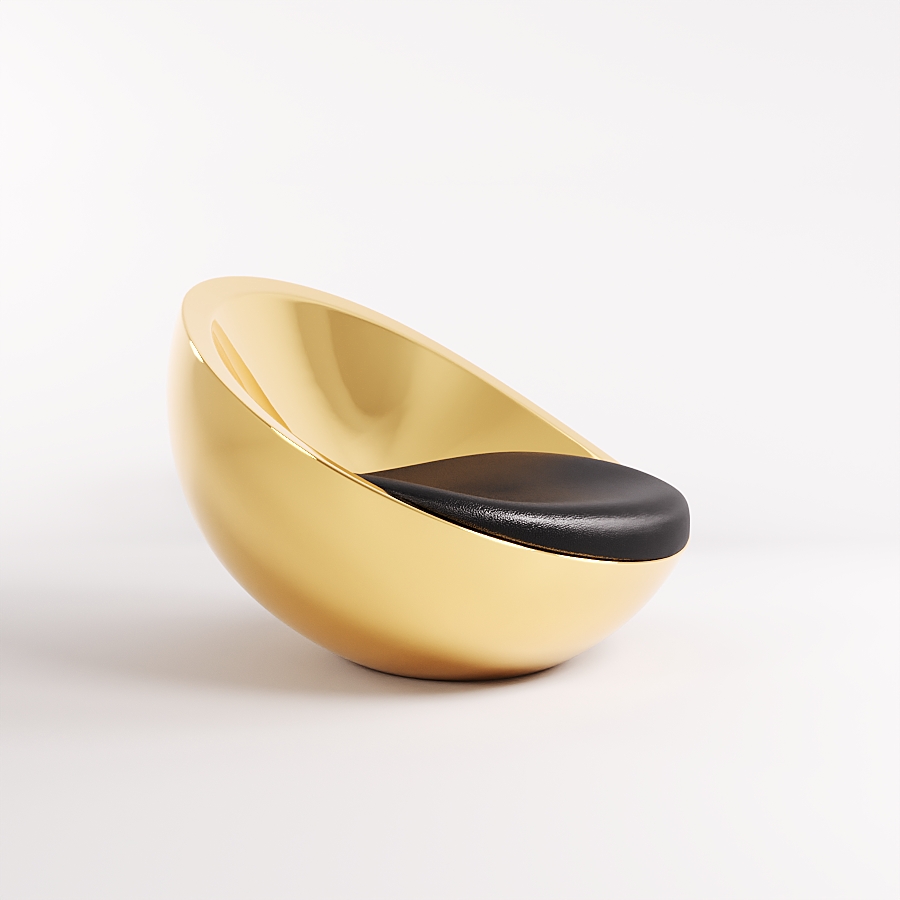
Inspired by the essential geometry of space capsules, the design uses a Carbon fiber chassis produced through a special autoclave process. The surface can be matt or glossy and can be coloured while retaining the characteristic carbon texture.
The upholstery introduces a softer counterpoint through natural leather, velvet or Alcantara.
Holo Carbon Edition
Holo demonstrates how Carbon fiber can be used within a more restrained sculptural object.
Its central body is made from genuine exposed Carbon fiber, while the aluminium rims remain visually distinct. Mavimatt states that the carbon is processed and applied completely by hand, with each central body worked individually.
Alunite and hybrid carbon structures
Carbon fiber can also be combined with other reinforcement materials.
Mavimatt’s Alunite is described as having a fibreglass and Carbon fiber structure, completely handcrafted, with a special black carbon edition available in matt or glossy finish.
This illustrates an important point about Carbon fiber furniture: not every piece has to be constructed exclusively from Carbon fiber. Hybrid composite strategies can be used when they support the desired structural and aesthetic result.
What Should You Look for When Buying Carbon fiber Furniture?
The appearance of Carbon fiber is distinctive enough that it can sometimes overshadow the more important question: what role does the material actually play?
When evaluating a Carbon fiber furniture piece, consider several aspects.

Is it genuine Carbon fiber?
First establish whether Carbon fiber is actually incorporated into the object or whether the piece simply reproduces its appearance.
A decorative carbon-look surface and a structural Carbon fiber composite are fundamentally different.
What is the structural role of the Carbon fiber?
Carbon fiber may form a structural shell, reinforcement, panel, chassis or another component.
The material’s presence alone does not tell you how the furniture performs. The design of the complete structure matters.
How is it manufactured?
Ask whether the piece is moulded, laid up manually, cured under controlled conditions, autoclave processed or produced through another composite manufacturing method.
For a high-end piece, manufacturing information can reveal considerably more about its character than the visual finish alone.
How is the carbon finished?
Matt, gloss, exposed weave, coloured carbon and different weave patterns can produce very different results.
The right finish depends on the surrounding interior and the role the piece is intended to play within the space.
Is the piece handmade or industrially produced?
This is particularly relevant to collectible furniture.
Handmade production can introduce individual variations and make the manufacturing process part of the object’s identity. Industrial production, meanwhile, can offer consistency and repeatability.
Neither approach is automatically superior. The important question is whether the production method matches the design intention.
Can it be customised?

For luxury interiors, customisation may involve dimensions, colours, upholstery, carbon finish, weave, surface treatment or combinations of materials.

A bespoke approach becomes particularly valuable when the furniture needs to respond to an architectural environment rather than simply occupy an available space.
Is it a limited edition?
For collectors, provenance and edition size can be important.
Mavimatt’s U.F.O. Carbon fiber, for example, is explicitly limited to 100 numbered pieces worldwide.
Is Carbon fiber Furniture Worth It?
Carbon fiber furniture makes the most sense when the material contributes something meaningful to the design.
Its cost is difficult to justify simply by saying that Carbon fiber is “strong” or “light”. Those properties become valuable when they enable a specific structural solution, a particular form, a reduced visual mass or a distinctive material expression.
Carbon fiber is also an expensive material compared with many conventional furniture materials, and the manufacturing process can require specialised knowledge and equipment. ScienceDirect notes that the economic case for Carbon fiber is particularly strong where weight savings or specific performance characteristics justify the additional cost.

In luxury collectible furniture, however, the equation is broader than engineering efficiency.
The value can also lie in craftsmanship, material rarity, limited production, design authorship, customisation and the relationship between the object and its environment.
The question is therefore not simply whether Carbon fiber is worth its price.
It is whether the material, the construction and the design together create an object worth keeping.
Carbon fiber Furniture vs Traditional Furniture Materials
There is no universally superior furniture material. Each material creates different possibilities.
| Characteristic | Carbon fiber composite | Wood | Metal | Fibreglass |
|---|---|---|---|---|
| Weight | Generally low for its mechanical performance | Variable | Often higher | Generally low |
| Specific stiffness | Very high | Material-dependent | Material-dependent | Lower than Carbon fiber in many applications |
| Fibre direction | Important | Natural grain influences behaviour | Generally isotropic in conventional forms | Composite-dependent |
| Form freedom | High | High, depending on construction | High, depending on fabrication | High |
| Visible material identity | Strong, especially with exposed weave | Strong natural character | Strong industrial character | Can be more visually neutral |
| Craftsmanship potential | High | Very high | High | High |
| Surface customisation | Extensive | Extensive | Extensive | Extensive |
| Manufacturing complexity | High | Variable | Variable | Variable |
| Recycling challenges | Significant for many CFRP systems | Material-dependent | Material-dependent | Significant for composites |
The comparison should not be interpreted as a ranking.
Carbon fiber is particularly interesting when its specific mechanical properties and distinctive visual language are relevant to the design. Wood can provide warmth and natural variation. Metal can provide mass, precision and permanence. Fibreglass can offer complex shapes and relatively low weight.
The best material is the one that serves the object.
The Future of Carbon fiber Furniture
Carbon fiber has already moved well beyond its traditional engineering applications.
Research continues to explore new precursor materials, composite systems, manufacturing techniques and recycling strategies. A 2024 review notes that Carbon fiber has traditionally been produced from precursors such as polyacrylonitrile (PAN) and pitch, while biomass-based alternatives are also being investigated.
At the same time, the growing use of Carbon fiber reinforced polymer composites creates a significant end-of-life challenge.
Recycling remains an open challenge
Carbon fiber composites are not automatically sustainable simply because they are lightweight.
Research into CFRP recycling identifies the difficulty of recovering fibres and matrix materials, particularly when thermoset polymers are used. Current approaches include mechanical recycling, pyrolysis, fluidised-bed processes and chemical or thermochemical methods, while researchers are also investigating recyclable thermosets and thermoplastic matrices.
This is an important distinction for the future of Carbon fiber furniture.
The next generation of composite design will not be defined only by strength, weight and appearance. Manufacturing efficiency, repairability, reuse and end-of-life recovery are likely to become increasingly important parts of the material conversation.
From engineering material to design language
The most interesting evolution may therefore be cultural as much as technological.
Carbon fiber began as a material associated with demanding technical applications. In contemporary furniture, it can become something else: a visible expression of structure, precision and material research.
For collectible design, that transition is significant.
The material no longer needs to imitate another material or disappear inside the construction. Its texture, geometry and manufacturing process can become part of the artwork.
FAQ About Carbon fiber Furniture
Is Carbon fiber good for furniture?
Yes, when the material is appropriately engineered for the intended application. Carbon fiber offers high specific strength and stiffness and can enable lightweight structural solutions. However, the performance of the finished furniture depends on the complete composite and its construction, not on the fibre alone.
Is Carbon fiber furniture durable?
Carbon fiber composites can provide excellent mechanical and fatigue performance, but they are not immune to damage. Carbon fibers themselves have relatively low impact resistance and low strain-to-failure, so the design of the composite, manufacturing quality and intended use are important.
Is Carbon fiber furniture lightweight?
Carbon fiber has a low density relative to many structural materials and a high strength-to-weight ratio. This can allow designers to reduce structural mass, although the weight of a finished piece depends on its complete construction, dimensions, hardware, upholstery and other materials.
Is real Carbon fiber better than a carbon-look finish?
They serve different purposes.
A carbon-look finish is primarily decorative, while genuine Carbon fiber is a reinforcement material that can contribute to the structure of the piece. If the objective is to obtain the material’s structural properties as well as its appearance, genuine Carbon fiber is the relevant choice.
How is Carbon fiber furniture made?
Manufacturing depends on the piece. Processes can include mould preparation, fibre lay-up, resin impregnation, consolidation, curing and finishing. Autoclave processing is used for certain composite manufacturing processes, but it is not an obligatory step for every Carbon fiber product.
Mavimatt explicitly uses autoclave processes for products including its Meteora Carbon edition and Nido Carbon fiber Edition.
Can Carbon fiber furniture be customised?
Yes. Depending on the manufacturer and product, customisation can include dimensions, upholstery, colours, weave, surface finish and other material treatments.
Mavimatt offers several Carbon fiber pieces with different finishes and colour possibilities, including matt, gloss and coloured carbon while retaining the visible texture of the material.
Is Carbon fiber suitable for luxury interiors?
It can be particularly effective in contemporary luxury interiors where furniture is expected to function as both an object and a visual statement.
Its strongest applications tend to be those in which the material is integrated into the design concept rather than simply added as a decorative surface.
How should Carbon fiber furniture be maintained?
Maintenance depends on the exact resin system, surface coating, upholstery and finish.
In general, exposed carbon surfaces should be treated according to the manufacturer’s specific care instructions, particularly where glossy coatings, coloured surfaces or specialised finishes are involved.
Discover Mavimatt Carbon fiber Furniture
Carbon fiber becomes most compelling when engineering and design stop being separate disciplines.
At Mavimatt, the material is interpreted through sculptural forms, handmade production in Italy and a focus on collectible objects. Carbon fiber can become a structural element, a visible texture, a finishing language or part of a bespoke design solution.
From the numbered U.F.O. Carbon fiber armchair to the Carbon editions of Meteora and Holo, the objective is not simply to use an advanced material.
It is to transform that material into an object with presence.
Not simply furniture. Objects designed to be remembered.
If you are developing a private residence, hospitality project, architectural interior or bespoke collectible-design commission and would like to explore a Carbon fiber solution, contact Mavimatt to discuss your project, requirements and possible customisation.
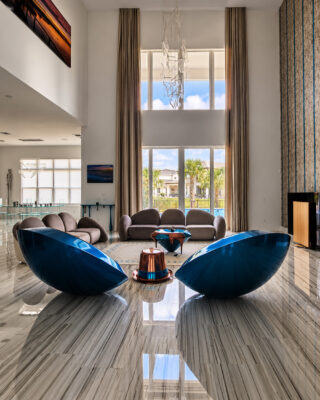
We’ve added a new pin to the Mavimatt delivery map: our latest destination was a private villa in Orlando, Florida.…
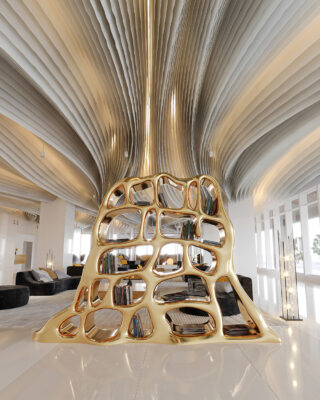
Looking at the Lava bookcase, one cannot help but think of the force of nature, the power of fire that…